
Blog
How Taro Powder Is Made: 7 Smart Steps for Premium Quality
Table of Contents
- 1. Selecting Fresh Taro
- 2. Washing, Peeling, and Slicing
- 3. Heat Treatment
- 4. Drying the Taro
- 5. Grinding and Sieving
- 6. Quality Control and Storage
- 7. Why Processing Matters
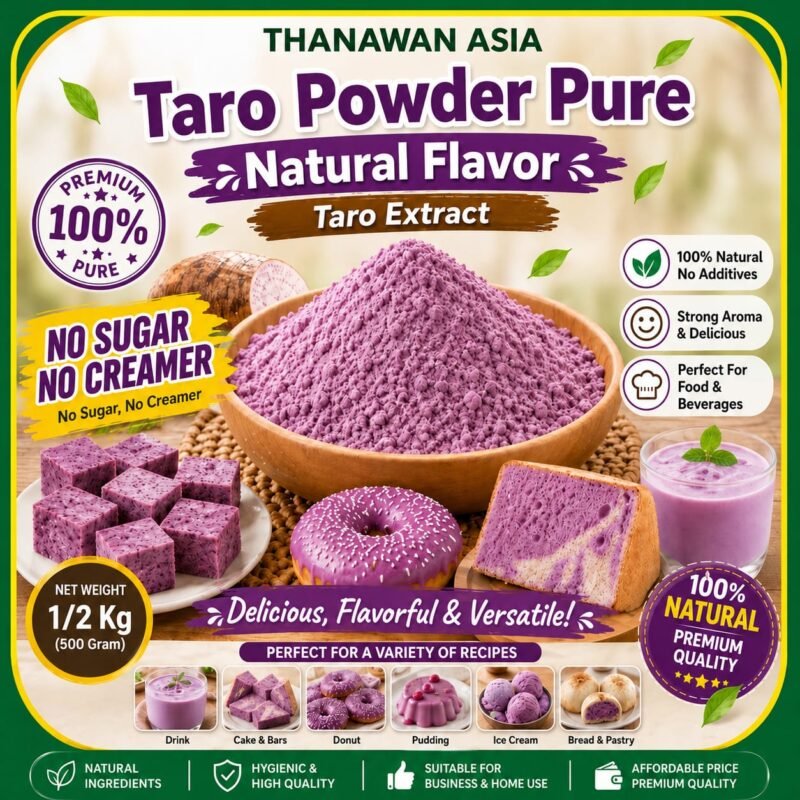
How Taro Powder Is Made: A 7-Step Guide
Taro Powder begins with fresh, carefully selected taro roots. Turning the root into a fine, stable ingredient requires controlled preparation, heat treatment, drying, grinding, and sieving so the finished powder has a consistent texture and useful shelf life.
1. Selecting Fresh Taro
The process starts with mature taro roots that are firm, clean, and free from visible damage or spoilage. Good raw material helps create Taro Powder with a more consistent color, aroma, and flavor.
- Select firm roots with healthy skin.
- Remove roots showing mold, excessive bruising, or decay.
- Choose lots with reasonably uniform size and maturity.
2. Washing, Peeling, and Slicing
Fresh taro is thoroughly washed to remove soil and surface debris. The roots are then peeled and cut into smaller, relatively uniform pieces, allowing heat and moisture to move more evenly during processing.
Uniform slices are especially important for commercial production because pieces that vary greatly in thickness can dry at different rates. Careful handling also reduces unnecessary contamination before the next stage of producing Taro Powder.
3. Heat Treatment
Taro naturally contains calcium oxalate compounds that can cause irritation when raw taro is handled or eaten improperly. Heat treatment, such as steaming or cooking, is commonly used to reduce these irritating compounds and prepare the material for further processing.
The exact temperature, time, and method depend on the equipment, taro variety, and desired product specifications. Processors should validate their own parameters rather than relying on a single universal setting.
4. Drying the Taro
After heat treatment, the taro pieces need to be dried until their moisture level is suitable for milling. Controlled drying helps limit microbial growth and makes the material brittle enough to grind efficiently.
Drying conditions should be managed carefully because excessive heat can affect color, aroma, and functional characteristics. Consistent airflow and evenly sized pieces can support more uniform Taro Powder results.
5. Grinding and Sieving
Once sufficiently dry, the taro is milled into a fine powder. Grinding equipment may vary according to production scale and the desired particle size, but the objective is a smooth, consistent ingredient.
The milled material is then passed through a sieve to separate coarse particles. This step gives Taro Powder a more uniform texture and can help manufacturers meet specific product requirements.
- Grinding should be controlled to avoid excessive heat generation.
- Sieving helps standardize particle size.
- Equipment should be clean and maintained to protect product quality.
6. Quality Control and Storage
Finished Taro Powder should be checked for appearance, aroma, moisture, particle size, and other specifications relevant to its intended application. Proper packaging is also essential because powder can absorb moisture and odors from its surroundings.
Store the product in a clean, dry environment using packaging that provides suitable protection from humidity, light, and contamination. Clear batch identification and good stock rotation can further support consistent quality.
7. Why Processing Matters
The journey from fresh taro to Taro Powder transforms a perishable root into a convenient ingredient that is easier to handle, portion, transport, and incorporate into recipes. Depending on its specification, it can be considered for bakery products, beverages, desserts, mixes, and other food applications.
Understanding how Taro Powder is produced also helps buyers evaluate consistency, processing controls, and suitability for their intended application. For additional background on taro, readers can consult this trusted reference.
Businesses looking for food ingredient information can also visit our website to explore available solutions from PT JEJU INDAH UTAMA and learn more about ingredient sourcing.
In short, producing quality Taro Powder is not simply a matter of grinding taro. Each stage—from raw material selection and preparation to heat treatment, drying, milling, sieving, and storage—can influence the final product.
Related Posts
7 Easy Ways to Use Dark Green Food Coloring for Cakes and Desserts
-
Posted by
thanawanasia@gmail.com
Chili Flakes: 7 Simple Steps for Premium Quality Guide
-
Posted by
7 Powerful Reasons Tuna Cube Works for Seafood Products
-
Posted by
7 Amazing Oregano Leaves Facts for Better Everyday Cooking
-
Posted by
Blue Food Coloring: 7 Premium Tips for Better Results
-
Posted by
7 Amazing Purple Sweet Potato Powder Uses for Food Production
-
Posted by
7 Essential Facts About Cheddar Cheese Powder Seasoning and Its Uses
-
Posted by
7 Essential Facts About Cheese Seasoning Powder You Should Know
-
Posted by
7 Premium Taro Powder Benefits, Uses, and Delicious Recipe Ideas
-
Posted by
7 Powerful Rosemary Leaves Benefits, Uses, and Culinary Secrets
-
Posted by